
As Shmulik, Nahshi and I arrived, Rami was already on site, doing what he knows best: explaining to a traveling couple about his birth area, Gaza space.
We joined them and got acquainted with Yair and Amira. Yair is a tour guide who came to travel but also to prepare a tour for next Saturday. They are from the north of the country and insisted that they are on their way but Nahshi’s coffee won out and they sat down. Yair talked about two concepts connected with Gaza – gauze and ‘gazette’. Gauze – a Napoleonic term was called thus because of the cotton from which this bandage is made, growing in Gazan space or even just sent through the Gaza port, and anyway was named after Gaza; ‘gazette’ – newspaper or newsletter – was called after Gaza because the ships bearing goods came from Gaza (whose port was the largest and most important in the region) distributed them in the various Mediterranean ports. The captain used to deliver the list of goods his ship bore and because these came from Gaza, the list was named ‘gazette’.
In the meantime, Mari and Ilan arrived. A short discussion ensued on the difference (if any…) between memory and consciousness. Ilan says that the difference between them is that consciousness is present whereas memory is past but contains consciousness.
Many guests arrive, and Rami explains about the circle and his own Gaza consciousness.
This is the point to ask forgiveness of our regular participants: because of the great number of guests this time, today’s notes summarize mainly the words of our new guests and whether any of the veterans had any new insights.
Rami speaks of childhood, adulthood and the circle of life neighboring Gaza.
Nahshi speaks of the good people he got to know in Gaza.
Shmulik shares an experience which we had not yet heard about: an encounter in the past with the families of Gazan potters who sit and work inside the ground! He shares the essence of Migdalor. He thinks it is political (as opposed to Rami).
Uzi remembers better days. Now he senses deep sorrow and a feeling of missing out. To the circle he arrives as someone who believes something could be done.
Yunka and Haim are former settler-colonists at Yamit (a settler-colony in the Gaza Strip that was dismantled). When Haim lived there, his life ran in Rafah, peacefully. When he moved from there to a Moshav at the Shalom area, the workers from Rafah would come there… Ever since Israel’s disengagement from Gaza he no longer thinks about what took place in the past nor about Gaza. In the past he worked in security in the area. He recalls the workers who came to work in all of the settler-colonies. There was no hostility until we were separated. He doesn’t look back…
Maharan tells us that in Gaza sat an Egyptian governor (prior to 1967) who used to send out infiltrators to damage Israeli communities along the border. The Israelis decided to assassinate him by handing an agent a certain explosive envelope which he was supposed to pass on, without telling the agent what it contained. When he arrived in Gaza, he opened it in the presence of Egyptian officers. Two officers were killed and the agent was blinded. Eventually, his son returned in Arafat’s delegation. Maharan says that there are gypsies in Gaza and he liked to attend weddings there because of the festivities and the belly dancing…
Mahmoud is a truck driver who passes on goods to Gaza. He has phone contact with traders. He enters a demilitarized zone with his truck, takes down his goods and returns after two hours to pick up the platform that was unloaded onto Gazan trucks.
Itzik has a bakery in Jaffa. Through the bakery he got to know many Gazans. They attended family festivities mutually. Now he has no contact with them. He misses them. He recalls a worker who was hard of hearing, and was a dough master. He would make very special dough, a real professional. Children 9-10 years old would come to the flea market and to his bakery to work. He really appreciated their determination and survival instincts. They did every kind of work with full dedication. At present the situation, thinks Itzik, is a total miss of leaders on both sides. After 1967 he thought that was the moment to make peace, but Israeli euphoria killed it all. He talks about a meeting in Gaza attended by respected businessmen, and when an Israeli officer, even a junior one, entered the room, they got up. That is what they were used to from Egyptian days. The businessmen were told that here this was not necessary but there were also Israelis who thought that if the were not “held” short, it would lead to disaster, we must show them who’s in charge now…
Pnina, Itzik’s partner, grew up in Jaffa with Arabs. There was respect for humans and their customs. She met Gazans at the bakery. They were always nice to her.
Malki came out of despair (still…). Here, in our circle, it is more comfortable… She wants the circle to continue.
Nomika tells us of about the films observed a week ago (this was already written about last week). The discourse with the group, different from everything familiar, artists, Arab and Jewish students sang together with artists there over the screen! For Nomika this encounter with such youngsters in Sderot was extraordinary. Art with political and social commitment. But reality has its say and the Gazans had to say goodbye before the electricity cut…
Dina says that one cannot remain indifferent to the goings-on in Gaza. Sadly, she has never been to Gaza. Too bad peace is waged with lands and not enough with the immediate neighbors. Dina was born in Alexandria and went back there on a trip with her parents and their stories. Now it’s dirty and neglected and signs that used to be written in English, Italian and Arabic were not only in Arabic. Reality is sadder than stories… Her parents were born in Egypt. In the past she worked in a civilian firm with someone who used to be Gaza’s military governor. She heard many stories from him. From her childhood she recalls the unfriendly saying “Go to Gaza!” (the Israeli way of saying “go to hell!”).
Mari came because of the circle’s atmosphere of containment, and her attraction to complexity.
Dror lives in Sderot. She was on a service year this past year, which means less thoughts about what goes on in Gaza. This is national service with youth in a movement that calls itself “culture through art”. She has chosen not to serve in the army.
For Nur, Gazans are a part of her life. She does not believe in borders. The Covid-19 virus illustrates the absurdity of borders. She does not “count” them, borders. They have no meaning nowadays. Perhaps they used to… Separation between humans now should not be continued. Gaza’s deteriorating health situation is our responsibility too, and will affect us. Just as the Gaza sewage, the neglect of which is our responsibility, affects the desalinated sea water that we all drink.
Mark thinks that Gaza is a daily reminder for the State of Israel that it has chosen the wrong path and continues in the wrong direction. Mark sees Gaza from his home window every day. Since it is quiet now, he is free to ask himself questions, why this situation?
Vivian has a story: she was the construction manager in Kibbutz Beeri. When her son was 5-years old and one of the workers did not arrive, he asked why. Vivian said it was due to closure. Why? War. Over what? Land. The child went to the cupboard, got a bucket and wanted to fill it with soil and give to the worker… Vivian says that Hamas is just as responsible as we are. But here, none of our people care.
Rami went to the north. It was raining. He wandered among the ruins of Bir’am village. A Christian Arab village whose inhabitants were expelled in 1948 with the promise to return. They have not been allowed to return to this day. A villager, Abu Nasser, whom Rami met, says – with bitter cynicism – that they are still waiting for those two weeks to pass so they can return… There is an Israeli national park there now. He went in. Got a leaflet that says not a word about the village history. Only the local church is mentioned… He met a friend from Kibbutz Bar’am who told him that they were directed to found their kibbutz on the village’s grounds. There are two factions in her kibbutz who argue whether exploding the Bir’am houses was justified or not. Further on his way he met an old man from Iqrit. They had coffee together. The man belongs to a vigil that sits there all these years to preserve Iqrit consciousness. Until the 1970s everything was deserted. A few years ago they came back and restored a part of this second Christian Arab village. Rami finds a resemblance here to us, to the Migdalor. He brought the story of Iqrit and Bir’am in order to say that the topic, in his opinion, is the fear to face and speak about injustice. At present the villagers number about 1800 men and woman, mainly in the village of Rame and some in Haifa.
Dina responds: we as Jews underwent similar tragedies. There is a problem in perpetuating tragedy. We got up as a people and got over the tragedy. This is way of the world – one continues! Perpetuating injustices makes people get stuck in their past. It’s frustrating. We have not learned out lesson either, but one must continue. See how problems are solved rather than perpetuated. In Uzbekistan she saw refugee camps and suffering children. The suffering of refugees exists in many places in the world. One must aspire to get out of the situation, not get stuck in it.
Mark has a hard time with Dina’s words and tells her that Zionism is all about remembrance of the past, which Dina asks them to forget. The State has not been true to its word to let the villagers return to their homes. A state does not behave this way. We are no better nor worse than other people in the world and Mark, personally, does not think we have a right to tell others what to remember and what to forget.
Nomika speaks of Israel’s broad activity in making Palestinian memory disappear. She reads out Shalom Chanoch’s poem/song – “Just like you”. This is our concluding chord for today’s encounter. Come meet us next week!
We were Yair, Amira, Rami, Shmulik, Nahshi, Oded, Mari, Ilan, Maharan, Mahmoud, Uzi, Malki, Dina, Nomika, Dror, Nur, Haim, Yunka, Itzik, Pepe (Pnina), Vivian, Mark
Wrote- Oded
Category Archives: Uncategorized


Encounter 143 – December 11, 2020
This time, for a change, our encounter began with art!
Roni brought an album she edited for her partner Ovadia’s birthday, in which his paintings are shown. Impressive. The album passes hands. Then Roni tells us about an encounter of “Another voice”. The message there was that “Nothing is being done…” About Migdalor, too.
Rami is alarmed. He thinks that the seeds sown in Migdalor sometimes get to unexpected places. He talks about an artistic alliance that was created for a joint Palestinian-Israeli project that sprouted from an acquaintance at one of the Migdalor encounters. This brought about an interesting artistic product. Rami met the creators and through him, they thanked Migdalor for being there and making possible the conditions for familiarization and creativity. Rami thinks that things do happen. There is no need to “push” activity by force…
Incidentally, there is talk of concentrating several student films and other creators at a single event. We have the content, and the audience, we only need a producer…
The noise of dirt bikes sounds from the entrance and dies out. I go there to see what’s up. The guys dressed in black take off their helmets and stare at me. I ask if they want some coffee, and they look at each other and… “Why not?” They come in, sit down, Shmulik serves coffee.
Rami says it all in his soft way (after all, black-clad motorcyclists) – he is from Kibbutz Be’eri nearby and was a kid during the 1967 war, with the innocence of a child. He remembers barbed wire that marked a border and women bent down in the field, and missiles in recent years and in his children’s childhood. Now disconnection. A reality which he refuses to accept. That is his Gaza consciousness.
The motorcyclists already get the picture… Before they get the floor, Rami adds that if peace is signed with Morocco and an Emirates prince purchases Betar Jerusalem Football Team, then everything’s possible.
Malki tells them and us that she comes here in order not to forget that people in Gaza are suffering. Our circle produces a different way of thinking that attracts her.
Elishai, one of the cyclists, grew up around here and heard his parents’ stories about the market and the beach at Gaza. He is grateful to us for our activity and wishes to experience Gaza in peace time.
Moshe, the other cyclist, says we surprised him. He is glad to see that there is such a “circle” that talks about Gaza. For him Gaza meant fear and bad things. Now, as an adult, his mind has changed a bit. He believes the world is going to a better place because strange things are happening.
Roni talks about the altered consciousness she acquired when she met Palestinians face-to-face during her farming mission-time in Egypt. It meant getting acquainted with the other side of the conflict. “No partner for peace” is a false slogan, she says, politicians’ slogan. There are partners, and they should be approached. The regime there is difficult and still there are people there who want other things. People are the partners. It’s important to see the people. 50% of Gaza’s population are under the age of 18 and have not met any Israelis. Roni tries to bring about virtual meetings between groups there and here. She sees the essence of the Migdalor and the possibility of shedding light on the people there.
Elishai and Moshe get up to continue their trip, say “Keep going this way” and leave.
Roni tells us of a Palestinian friend who visited the circle in the past. He studies in Israel and for bureaucratic reasons his visa was not renewed and he will have to leave the country in a few hours. In his desperation he tearfully turned to Roni. She got to it immediately! The matter was settled within a few hours. Roni is moved when she tells us about this, and so are we. Roni was helped by the Gisha organization, which looks after the freedom of movement of Palestinians who wish to leave Gaza for different purposes.
Rami calls up the Palestinian, who wishes us a happy Hanukka and says everything’s worked out.
Roni continues to tell us about a group of girls from a pre-military course, who came to meet her for a tour of the moshav. From their style, she realized what they hear at home. Their questions attested to it. But they listened very carefully to Roni’s answers and insights, and after a few days sent her an excited letter of thanks for her activism, her tolerance and her humane and containing attitude.
Shmulik tells about his activity as a youth in leftist organizations.
His anti-Zionism irritated even his peers. Shmulik says that his brother, who has had a glorious military career, complained that his “leftism” damages his military career…
Roni calls Gaza. We speak with Khalil who tells of his wife’s birthday and the original gift he arranged for her, video segments of friends wishing her a happy birthday.
Rami talks with him about Hanukkah light – the light being brought to the area. The smile it raises. Khalil wishes to come to the circle, and Rami makes the circle come to him by giving him a tour of all our faces in the circle, via smart phone.
Malki wishes that we see him come in this entrance, live (she points at the entrance to the sulfur plant).
Hayuta reads out a poem by Nathan Zach (who died recently).
Brian arrives. He comes often, may this continue… Rami asks him to tell what makes him join us. Brian says it gives him a sense of doing and not just talking for the sake of impressing anyone. Here people talk and do honestly, not phony. He tells Shmulik that he differs on his “sense” of Zionism, but it comes from a real place, not fake.
Bella says she was once punished by her father for having gone to celebrate May 1st.
Hayuta tells us about how she got off school for May 1st.
Rami marched in Tel Aviv with a red flag.
Shmulike says he’s a communist and an individualist.
Brian says this is a contradiction… Shmulik gladly agrees.
It’s already 4 p.m. but Patrician and Adi arrive. Agronomists. We stayed to have coffee with them. Rami summarizes about the sulfur plant and about us. They talk of themselves and what Gaza means to them. It’s 4:20, mingling before breaking up, and going home.
Participants this time were Shmulik, Bella, Mari, Hayuta, Roni, Oded, Rami, Malki, Elishai, Moshe, Brian, Patrician, Adi.
Wrote – Oded.


Encounter 142 – December 4, 2020
Hello, shalom, ahlan –
We opened our Migdalor circle – Shmulik and myself – with hosting two couples of travelers: Avi and Shula from Alumim, and their guests Galit and Yossi from the Golan. Apparently Shmulik and Avi had known each other previously as they are both certified dairy farmers (Shmulik is an Emeritus dairy farmer…). They sat with us and had coffee, showed interest. Galit expressed her appreciation for the idea and the execution. They left without leaving behind any kind of “Gaza awareness”. As they were leaving, Roni arrived, with Anne and Steve. Steve seemed a bit surprised to see only two elderly men in a circle of empty chairs. We told him that it’s only going to get better. Anne and Steve are both Americans, so our circle proceeded in English. I mention English because it is connected to my summarizing in Hebrew…
The circle participants probably notice that I am recording the circle statements in order to summarize later on – but my English leaves something to be desired, and I have a hard time writing in Hebrew and listening in English. Therefore this summary proceeds by leaps and bounds, translating while listening, and missing out on sentences in English.
Today, I lead the circle, and mention the reasons for my activity in our Migdalor.
After me, Malki has the floor. She says that after moving to Gvulot she became much more aware of Gaza and the fate of the Gazans. Physical proximity brought her closer mentally and she became very concerned with them. That is why she comes to Migdalor every week.
Uzi, too, arrives nearly every week. He says: “My kibbutz, Gvulot, was founded in 1943, and I am proud that it happened without battle nor violence. My British birth certificate says I was born in Palestine and I like saying I am Palestinian. Over time, this has grown stronger: whenever I met Arabs in Egypt, Lebanon, Jordan and elsewhere, I realized that Palestinians do not resemble them, they resemble us more – us Jewish Israelis. For me Gaza means very deep sorrow and a sense of loss, for which both sides are responsible.”
Ghadir is with us today, too. She is glad to be back after a Covid-19 break. She thinks Israeli Arabs have an important role to play as they are the bridge to peace. She remembers Gaza from her childhood, when she went there on family vacations. Ghadir is active in various social and inter-ethnic groups for peace. She wishes to leave behind a better world. Ghadir does not have children and for her, all the world’s children are her own. Even when she will no longer be here, she wishes to be certain that her family and friends continue to be active for reconciliation and peace.
Shmulik thinks we bear responsibility and may not ignore the situation.
Anne understands the “spirit” of Migdalor rom listening to speakers before her, and is very sympathetic.
Her partner, Steve, a journalist for the Washington Post, is here on a job… He is writing an item on bridges and ties between Israelis and Palestinians. He is glad he came here with Anne for she always exposes other and different angles that do not occur to him. Steve is writing a story about Roni’s ties with a fellow in Gaza and uses the opportunity to familiarize himself with different aspects of neighbor relations with the conflict in the background.
Uzi is concerned for the security of the Gaza fellow, and Steve answers that it is all done with coordination and agreement. Roni, who has brought Anne and Steve to the Migdalor, says she speaks with the Gazan on a daily basis. Mostly just to speak. At times about his life, his family, and the general situation in Gaza. He wants people to know and act for Gaza and emphasizes the importance of knowing and being active. His talks with Roni make him feel good. He has no work at present. He wishes to get out from Gaza for a while and come back. Roni says that the American hospital will be opened on December 21st.
In the future, a theater hall is also in the planning. Roni will be the Israeli coordinator of the hospital.
Nomika lives in Sderot and is a member of the “Other Voice” organization. She agrees with everything that has been said… She mentions to Steve and during the first Gaza war, she was interviewed by the Washington Post…
Nur too lives in Sderot. She thinks about the horrific situation on the other side, and that we live our lives as if that were normal but it is not. People on the other side are hurt and we enable this. They are on her mind all the time. Far but near. Coming here is her way to protest. She is a pacifist. She decided not to serve in the Israeli army. She does not wish to harm anyone. It was clear for her that she was not going to the army nor to jail…
Rami says he visited the Haran area in Turkey (origin of our Forefather Abraham), in the town of Urfa. Local myth there has it that Abraham was born in a cave in that area. Rami and his friends hid their Jewishness (they said they were New Zealanders) but were immediately identified as Israelis. When he said his name was Ram (sic) and mentioned that he lived near Beer Sheva, he was greatly honored. Both because his name sounded like Abraham and because Beer Sheva is tied to his name. Thanks to this they got to enter the holy cave.
Vivian identifies with Nur. She recalls that one of her sons too did not wish to enlist. She feels we must be more active. Vivian has a friend who escaped from Gaza to Ramallah when Hamas rose to power in the Gaza Strip, and feels like a refugee in Ramallah…
Towards the end of our encounter, we spoke with Mustafa (pseudonym) who lives in Gaza. He wishes to be in touch with us, work together. Positive thinking is necessary for change to take place, he says. We must find people ready to confront and act.
Finally, Ye’ela also showed up…
This time, participants were: Galit, Yossi, Avi, Shula, Uzi, Ghadir, Shmulik, Anne, Steve, Roni, Oded, Malki, Nomika, Nur, Rami, Vivian, Ye’ela
Wrote: Oded


Encounter 141– November 27, 2020
Winter is here and has made us decide to hold our circle inside the sulfur plant ‘skeletal’ structure. The decision was taken in a deep discussion among Shmulik, Nahshi and myself on our way to the “Migdalor”. We picked up Hayuta on our way.
We get there, get organized, and realize we forgot to bring water with us…
Luckily Maharan arrives, with a container of water in the car. A call for help which Nahshi sends out on our whatsapp group is answered by Mari who promises to bring more water.
In the meantime, Maharan, a lawyer and teacher (citizenship and history) tells about some of his experiences as a lawyer and slips into an interesting historical review in which he details spatial allotment according to the Bedouin tribal organization system. Maharan says this entails the entire Sinai peninsula, the Negev desert, ‘Trans-Jordan’ and a bit further to the north. This division also stretches in time, namely from the 18th-century on… Fascinating.
Shani and Or arrive, the film students from Sapir College who filmed, edited and presented a short film about the Migdalor as a part of their studies.
Maharan goes on from Bedouin history to American stuff, giving us a sociological explanation of Trump’s fall. He proceeds to the fall of the Israeli Labor party (Barak finished that one off…), continues towards various versions of the end of the world in different belief systems, tells us about the dynasty of Genghis Khan, his sons and conquests, and finally ends up this world-history review with his conclusion that all of North Africa is descended from Palestinian Canaanites…
Mari arrives with her promised water, as well as Nur and Nomika.
We hold an acquaintance circle to catch up.
Maharan tells us that in the Gaza Strip they’ve lost control over the Covid-pandemic. The only way out now is ‘herd immunity’.
Nomika updates us on getting ventilation machines into the Strip.
To my request, Shani tells us that their film about the Migdalor received warm professional reactions, but because of details that might endanger others, it was seen only by their classmates, lecturers and us. 15 minutes-long film edited from 30 hours of shooting… Editing was a frustrating experience. Eventually they focused on the editing, with despair and hope of the average person as a leading theme. Shani also made a film based on a conversation she had – with the help of Ghadir – with Warda, the caregiver of Iyad Al Halaq who was murdered by Border Police in East Jerusalem. She focused on reactions of people who hear her interview with Warda.
Nomika reads the invitation to the film made by Adir and Liora (not yet screened…), also students at Sapir who have come (and will return?) to our circle. This film too could not be screened because it is based on contact with people from Gaza. We are considering holding a small event for invitees only to watch the three films.
Brian arrives and introduces himself. An ex-lawyer from Virginia.
Since Maharan is a lawyer too, right away a discussion ensued about psychopaths and good people…
Nur, encouraged by Nomika, reads us two poems she has written on her personal experience in the stormy relation with her Gazan neighbors.
For Brian’s sake we hold another acquaintance circle, this time emphasizing the matter of “Gaza awareness”.
Mari speaks of the complexity of these relations that attracts her to come to the circle and understand more.
Nahshi speaks with friends in Gaza. He talks them from time to time. The circle is interesting, new, people are showing interest. Waiting to get back to some semblance of peaceful routine.
Hayuta comes to support the supporters… Less across the fence.
Nur thinks about “Nur” who lives in Gaza and what her “double’s” life is like.
Nomika, 14 years after founding “Another Voice” wishes not to lose the ability of seeing the other’s suffering. Over the years, ties have formed.
Shmulik speaks of a single space in which he is partakes, hoping for one human space.
Shahak arrives on foot towards the end of our meeting, with a backpack, as he left his vehicle behind. He has been living temporarily in Kibbutz Nir Yitzhak, and a talk with Shmulik aroused his curiosity to come and join us. He doesn’t know Gaza. He came to the vicinity in order to get to know the inhabitants of the Israeli side. Although he runs for his own pleasure through the kibbutz fields and arrives at the Gaza Strip fence, it doesn’t make him want to get to know those who live on the other side.
Brian lives in Ashqelon. For his fellow inhabitants there, Gaza is the origin of missiles. He has come in order to remember that there are human beings living on the other side. Whoever doesn’t know that thinks that the ‘other side’ consists only of beasts, he says.
Or says that until he came to film us, Gaza for him was a mystery. And didn’t interest him. Filming and meeting us made him get interesting and realize that there are people over there who are suffering, but Corona has overtaken the interest in Gaza, again.
For Shani, Gaza has been quite an issue with her conscience lately. She has heard some details from a veteran member of Kibbutz Nir-Am whom she met while observing Gaza. He gave names to places she saw with her friend, and told them of villages that no longer exist. Shani realized how much her generation lacks information.
That’s it. We were thrilled to see Or and Shani again, listen to Nur’s sensitive spirit through her poems, see Brian for the third encounter in a row, listen to Maharan’s abundant knowledge, and as usual – drink Nahshi’s coffee…
Participants: Maharan, Shmulik, Nahshi, Hayuta, Shani, Or, Oded, Mari Nomika, Nur, Brian, Shahak.
Wrote: Oded

Encounter 140 – November 20, 2020
We meet, have coffee, hallah, and make small talk about everyday trivia.
The important things begin to come up when Roni tells us about her Zoom encounter with 11th and 12th graders. They listen most interestedly, she says. It’s rather surprising and thrilling. One teacher asks/says that “I – unlike you – think we’re giving and not getting anything in return”. Roni says, “It’s important how one gives, not just what…” I ask her if facts would not have mattered a bit, and Roni says that dialogue is more important than confrontation, and anyway some facts did sink in and eventually, from every Zoom ‘window’ nearly all students said it really interested them, and even the teacher said to Roni that “she had given him food for thought.”…
Hanan speaks about Uri who joined us last week and challenged the (would be) “consensus” with a different opinion. Hanan thought about what Uri had said on his way home and summarized for himself that we’re here to preserve hope, not to solve the problem. On another matter, Hanan met someone who knows Rami and when he mentioned Rami, his conversant said “Oh, Rami from Migdalor…” For Rami this was proof that Migdalor has more publicity “than we are aware of, in fact”.
Brian arrives. He came as a traveler last week, was invited for coffee and came back today (do not underestimate Nahshi’s coffee-making powers😊).
We do an acquaintance circle so that we all get to know Brian and he gets to know us.
Brian came from the US about 10 years ago, and teaches ‘debate’ in several venues. The Hebrew for this concept is debatable, and Roni tells us that the Hebrew Language Academy set the word ma’amat as the official Hebrew translation of the English ‘debate’.
Afterwards, Malki introduces herself, saying she comes to refresh herself in the company of good people and not forget the condition of our neighbors’ lives.
Jaber emphasizes the problematics of his village Al Zarnouk and says that although he comes from a place that suffers harsh discrimination by the state institutions, he cannot forget that in Gaza suffering and despair are much greater. Here with us he feels good, it calms his spirit.
I say that one of the reasons I come is the fact that those “fence events” began parallel to the founding of our circle. I thought, so I said, that people from the area would arrive with a different mode of thinking and would find listeners for it here in our Migdalor circle. As for the shooting at the Palestinians that took place in those events, I said that “shooting was performed by our moral soldiers”, which had one of the circle participants remark “no to cross lines…”
Anyway we stopped our acquaintance circle because a friend from Gaza just called.
At the moment he is home in Gaza, but plans to get out as soon as he can. He wants to leave as a private person, not as a “representative” of a political or social organization. Jaber speaks with him in Arabic and translates. The friend says that at the moment it is very limited, and politically one must let time do its job. It’s a hard period for him right now. In the past he made his living as a journalist, and can get back to it, but the social activism he had been involved in is now a problem. He is less concerned with himself, and more afraid that his work would be hampered. Nomika asks where he would like to go? He does not mention a specific destination. He just wants to do it at first possible moment. He mentions his will to come back to Gaza stronger (perhaps with an added – citizenship – my own interpretation), perhaps with a different status that is not subject to the regime’s caprices. He is known publicly, and cannot or doesn’t want to become anonymous again. He does not want to be prevented from expressing his opinions or acting for the sake of the community as he believes should be the case. The thought that he is harassed because of his opinions and activity is a source of despair. His family, too, is pressured by its surroundings. He has an idea to enter business with a relative, vis a vis Israel. At some point he suggests that Jaber “keep his place in the circle” because he is sitting with good and honest people (we?)… He says that the “project” he set up is rather strong, and he thinks that his leaving will strengthen it further. Rami tells him we all think about him and let everyone have a round with his cell phone. We all greet him and are greeted.
Rami dwells on Nur with his cell phone, and Jaber tells him that Nur managed not to be drafted into the Israeli army on grounds of conscientious objection. He appreciates this very much. We take leave of our Gazan friend.
Rami asks if there was anything new this week in connection with Gaza. I told him that the coordination with the PA following the change of power in the US has been renewed, and it is helpful for ill patients’ transfer through Israel.
Roni says she heard that the Gazan health authorities have run out of funds to pay for patients going to Israel for treatment, and perhaps they will only get out to hospitals in the West Bank. This is really not good news.
That’s it. There must have been more important things. Whoever can think of any is invited to add them…
Today’s circle included Hana, Brian, Nahshi, Shmulik, Roni, Oded, Jaber, Mari, Nur, Nomika, Malki, Rami 1, Rami 2.
Wrote: Oded


Encounter 139 November 13, 2020
All because of a little coffee pot.
When it seemed that we were a motley few, we spread our gear and found out that our coffee pot was forgotten at home… What’s to be done?
Nahshi, whom Shmulik had caused grave guilt feelings, was assertively sent to the storeroom at Kibbutz Be’eri. When he took his time and our throats were crying out in desperation, he finally showed up with an Arabic coffee pot, but our disappointment grew as it turned out to be full of holes.
While we were still wondering what to do, two youngsters arrived on a handsome buggy. They saved us from social death. Non-chalantly they treated us to coffee in their state-of-the art pot. Thus we began our hospitality circle with Ron and David, both from Netivot. Ron is headed for office training in the Giv’ati infantry corps, both are cadets of the military academy at Reali High School in Haifa. They spoke of themselves as listeners, hearing a different kind of music they usually hear at home. They did admit that they have been hearing the other voice at school.
Another guest followed – Brian from the US, with multiple interests in work, who at this point in life is busy teaching debate at a Hura high school and in the Bedouin communities. Brian picked up our talk easily and certainly blended in, claiming that the conflict is derived mostly from hatred.
With time, Rami arrived, who began sorting out his books but felt in strong need of caffein so came to have coffee with us.
It is important to mention that Shmulik was our country guide specializing in the Be’eri area. Last of our guests was Uri Utin who came to say that he does not agree with peace through mere dialogue.
Present, having coffee, eating and debating were Shmulik, Nahshi, Roni, Hanan, Brian, Mark, Ron, David, Mari, Uri.
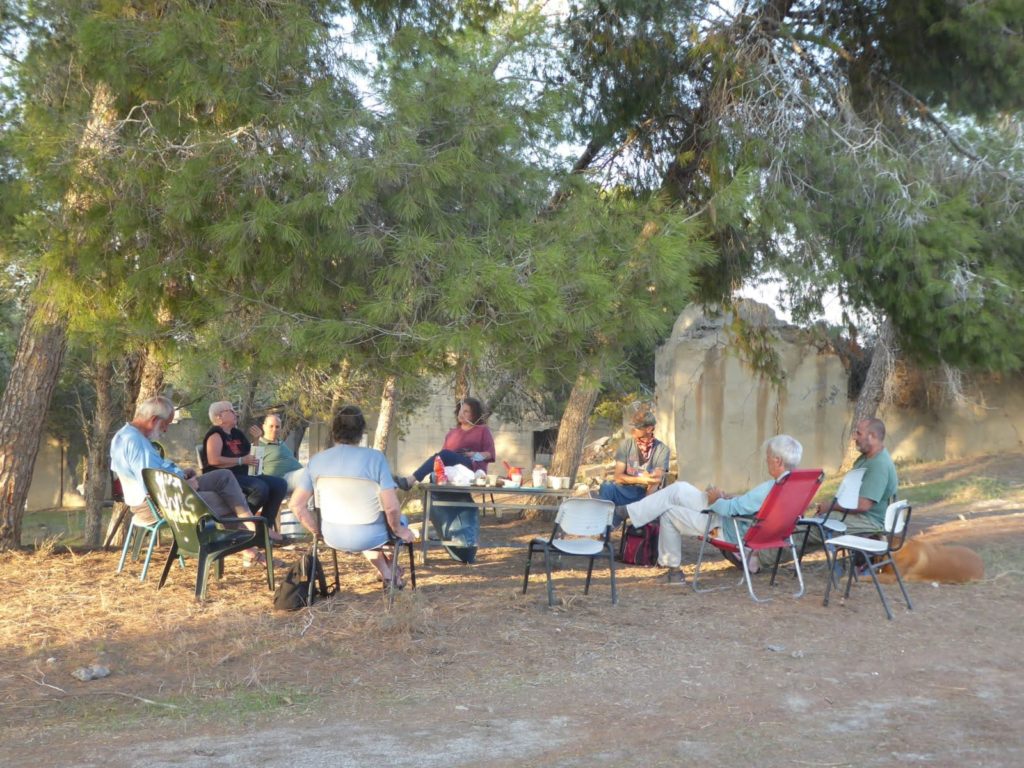
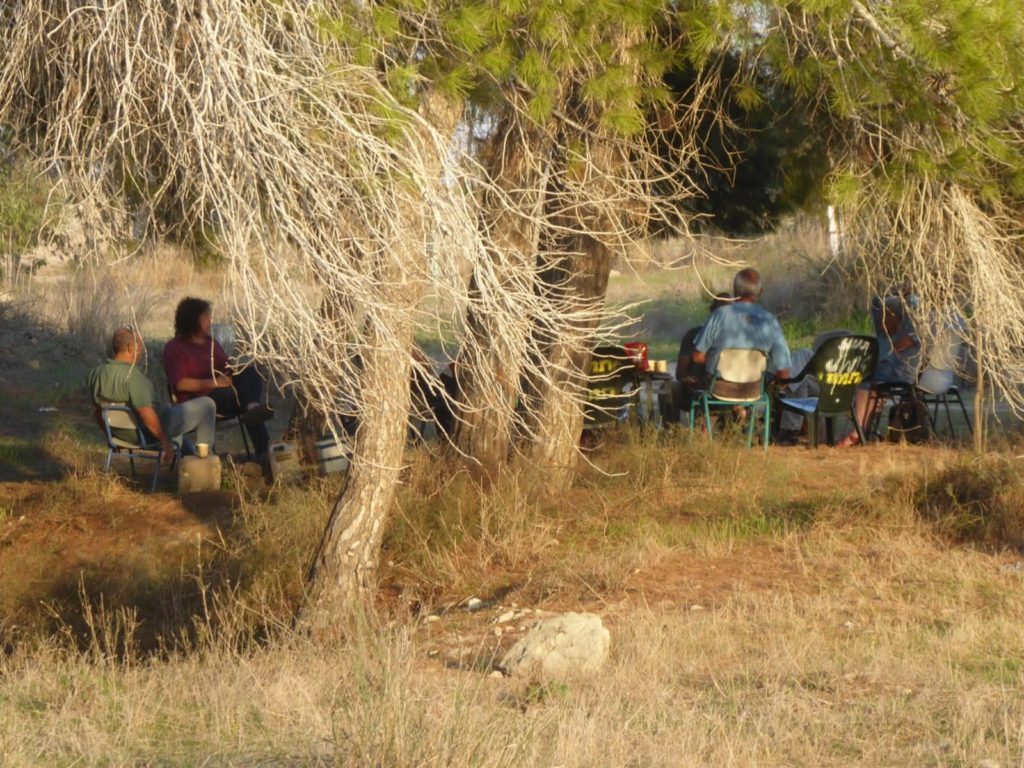
Wrote: Hayuta

Encounter 138 November 6, 2020
Two and a half years of Migdalor activity. A kind of routine… Routine normally does away with the excitement of “big beginnings”.
The usual disadvantages of routine are exacerbated by the Corona pandemic that cut down the main branch on which we sat, namely our chance encounter with Israelis who come out to hike in nature and find themselves in a discussion circle about Gaza consciousness… People stopped traveling – Corona!
Another central branch on which we leaned were our talks with friends and neighbors whose misfortune had locked them in an insulated area, surrounded by fences and armies. And here’s our good Friday… today!
We opened our circle with Itay and Shiran, a young couple traveling at their leisure, who welcomed our invitation for coffee, listened and was heard, too. They sat and listened to the “circle”, and when their turn came they said that in fact they had never really considered what was going on beyond the fence, and that the information they had was what Israeli media deliver… Hopefully their encounter with us will generate some change in their awareness.
But the climax of our ‘lighthouse’ this time was undoubtedly our meeting with an ‘old’ friend who for the past months had been prevented from contacting us. The thrilling words that follow are Roni’s: “we had a very thrilling encounter, the possibility to see and talk with a dear friend from Gaza after months of separation during which we had no contact. He told us what he underwent all that time. The strength he gained from the mere fact that we are here for him.
His smile and thrill were inspiring and gave us hope for the future.
We did not let communication difficulties deny us this important contact which reinforced in all of us the belief that we are all a part of a single space, sharing a single texture, hearing and seeing one another, loving one and another and believing in one another. We passed on information, updates and good tidings.
We shall do everything in our power to make this contact grow and expand, and light will remove darkness. We hope that with time clear words with names and faces will be spoken, so that more and more people will know that we and they have partners, working tirelessly.” So far, Roni.
And I add that from the moment contact was renewed, he asked that we be his very first contact! Of all the many friends who waited to hear from him! We realized he is aware of our concern and that we hold the lighthouse shining for him as well.
16 participants joined our circle physically, another 6 shared it in Zoom for part of the encounter.
Between different thrills, we were happy to hear from Julia about the end of the important research she conducted about inhabitants of the area in the shadow of the conflict, and raised a toast for some significant birthdays and new retirees. We drank to the health of our renewed contact with the neighbors (there was also talk about Biden – teaser to Jeff Parnas…).
To everyone’s health!
Present: Maharan, Rami, Nahshi, Limor, Mari, Shmulik, Roni, Arik, Bella, Oded, Uzi, Malki, Mark, Julia, Itay, Shiran. Zoom: Rami, Hanan, Uri Ben Asa, Rosie, Jaber, and for a moment – Liora.
Wrote: Oded


Encounter 137 – October 30, 2020
We met, no questions asked about who is still expected and how many we’d be.
We began – Roni, Shmulik, Nahshi and myself.
Nahshi made coffee. Obviously…
Roni tells us in detail about our Gazan friend who just got out of jail.
Hanan arrives, Roni repeats… How he was released, what he look like now, what he said. She goes on to tell about the musician who needs to complete his studies but has no money, and how she transferred some. Also about the woman who got out of the Gaza Strip and met her father. Human stories about the hardships met by a person whose fate has hurled him into a cruel reality.
Jaber arrives, Roni repeats a third time. Well, in outline…
We proceed with a “free” discussion.
Hanan leaves, Mari arrives. Weather permits her to do so at long last. Roni has a fourth go. We Mari – we hadn’t met for a long time (Zoom is just make believe) so she has to provide answers. Questions about Corona in her community, and family ties, so common an item in Israeli get-togethers.
Mari is a member of her community’s emergency team. As a Ministry of Health retiree, she has access to information. The pandemic plays with us, she says – it attacks again some of those who have recovered, has various expressions, no one has a clear answer. Scientists are at a loss.
Then she says that as she drove to our site she wondered – how do we mediate our activity to our children? Are they at all interested?
Some question… The “circle” re-organizes for a discussion of this interesting question. It breaks up in different directions, and we must focus among the speakers.
First travelers of the season have already been spotted around here, none joined us. Perhaps they will, after the first rains.
We’re already close to finishing time and it gets dark early now that we’re on winter schedule. Mari’s question will keep us busy next week too, I guess, when we shall also light our lighthouse to enable hopeful navigation…
Wrote: Oded


Encounter 136, October 23, 2020
After some weeks when we held our Migdalor meetings only on Zoom, we got together again near the deserted sulfur plant. Shmulik and I picked up Hayuta, came to the site and found Rami there, who had already made himself comfortable on his chair, in the pleasant breeze.
Roni came, as well as Jaber, and Hana with his cap. The circle was completed by Malki, Bella and Uzi. 10 in all.
Everyone knows everyone else, but still we “go around the circle” with introductions… Each in their turn share their feelings these days.
The pandemic and the political chaos affect all of us, not necessarily in a bad way… Some see them as opportunities for a new reality, others find it difficult to adjust, and some simply go with the flow… Life leads and feelings are put aside.
We opened a broad discussion of Gaza, that began by Roni reporting on the state of our friends there. The discussion slipped into political-historical dimensions in the context of the Gazan space, trying to decipher the “true” intentions of the Israeli side. Everything in the context of humans and land, of course. Indeed, in our inner circle we try to focus on humans living in this space and less on political rulings and regime actions. Needless to say, these things are interconnected and one canot help but relate to the political system as affecting people and land, and still we navigate “Gaza awareness” in our meetings, especially with relations that come into being, “eye to eye and heart to heart”.
This time, without the direct contact, we slid into politics pure and simple… Naturally our discussion was justified, in light of our usual interest (at least I find it so), and lasted much longer than the official plan.
In our departure mingling, Hanan came up to me and said that relating to the opinions I aired, I actually spoke about “Zionism”. I was surprised, since I had not mentioned it at all. But on second thought, he was right… I realized that if we place “Zionism” on a spectrum of our being in this space, we would find various doses of it in every single one of us. Consciously or unconsciously. From its total negation to its undisputed justification. Even without using the actual term itself…
That’s it for todeay. I introduced the participants in the beginning.
Wrote: Oded


Encounter 134 – October 9, 2020
Along the 140-year timeline of “the Jews’ return to their land”, “national revival” and its connection with Eretz Yisrael (the appellation embraced by Zionism), there is the assumption (not entirely articulated) that there have been “junctions” wherein events took place, breaking the potential equality in Arab-Jewish relations.
The question I raised for the sake of this encounter was as follows:
“… What was the moment to which you would return on the timeline, when the balance of fairness and seeing the other changed, and from whence the polarized reality we see today developed in fact.
Or simply put: to which point in time would you return?”
This was the question discussed at today’s Zoom meeting we held, articulated by Rami.
First to relate to this was Tal, telling about her grandmother, born in Palestine in the turn of the 20th century to first Aliya (Jewish immigration wave) Zionist parents, who wrote as a young girl about her deep-seated fear and contempt of their Arab neighbors.
Mari said that in her opinion, the fact that the Faisal-Weitzman Agreement signed on January 3, 1919 was not materialized, brought about that “separateness” which Rami defined in his question as causing the present situation in our space. This agreement defined cooperation between the Arab space then named “Greater Syria” (more or less the area today shared by Syria, Jordan, Israel and Lebanon), headed by Faisal Ibn Hussein, and the idea of a Jewish “National Home” in the spirit of the Balfour Declaration of November 2, 1917, an idea that Haim Weitzman represented in the agreement. Faisal signed upon the condition that the Arab State would receive its independence of Britain. However, the agreement was undermined by England and France and was attacked by its opponents of both parties. Mari claims that the fact that this agreement could not materialize was a critical point in the relations between Arabs and Jews in this area.
Nahshi began his words by agreeing with Tal who implied that animosity was inherent from the beginning of Jewish “national revival” and adds that on both sides, giving up claims is “translated” into weakness and resulting violence. From there he leaps to “stations” closer to our day, when attempts were made to give back “things we took by force”… The purpose of such attempts may have been only “a guise” as he put it, but even “a guise” is important. Nahshi says that at points such as the peace accord with Egypt, the Oslo Accords or the accord signed with Jordan held willingness and good will towards agreement, and this did not work. Clearly for him the solution must lie in the study and recognition of the different narratives of both sides.
I said that we must remember that one half of these 140 years were lived here under either the Turkish Ottoman or the British rule. I believe that no colonialist regime during that period had taken land in order to give it back… Therefore, both Arabs and Jews had to plan their lives as subjects, not as sovereign citizens. The Jews, who throughout their history had adopted a narrative of persecution, developed a strong tribal cohesiveness and had a difficult time assimilating in this space other than as a separate ethnic group. If this protected them in the course of history (even at times when it was forced upon them, and paradoxically preserved their strong ethnic cohesiveness), why wouldn’t it protect them now in this new space they came to inhabit? This separateness led to mutual animosity that has lasted to the present day.
Roni received from friends a video that shows how ever since Bible days and throughout history, this space has always been the bone of contention over land. In other words, “that which has been will continue to be”. Her reaction was that this does not have to continue. She realized the ties of a community or a people to this place while she was on a farming mission in Egypt. There she realized that another narrative exists, different from the one she had absorbed here, and that each side is absolutely right from its own perspective. In the high school she worked at in Egypt, during her mission, a student – son of an Emirates ambassador – asked her whether she agrees with what the Israelis are doing to the Palestinians. She answered that she did not agree, and that she is anxious about what this makes of us as human beings. When her daughter asked her before this Zoom encounter which point in time she would choose as generating animosity, Roni said that her choice perhaps would be the 1967 War. Her daughter indicated that right after this war relations were excellent, and Roni claimed that perhaps on the surface this was right, but the “subterranean currents” already gave off the feeling that something bad was going on here. From the book written by journalist Ohad Hamo, “The Surface”, she quotes a conversation Hamo had with a senior Hamas official who told him they would not give in, but also said that he understands the Israelis who are so convinced that they’re right. Hamo thinks that this is a positive point from which one could advance.
Malki refers to Wikipedia: under the heading “Jewish-Palestinian conflict” it says that the conflict began in 1860, when the Jewish neighborhood of Mishkenot Sha’ananim was built outside the walls of the Old City of Jerusalem, an act that symbolized action and a declaration of presence on the part of Jews in this space. But for Malki personally, the 1967 occupation marks the breaking point. She does not underestimate 1948 or other points raised in the discussion, but for her that is where the line was drawn. Indeed, there were several chances after that, but as soon as we did not take the right measures immediately following the 1967 War, things just moved downhill. Ever since, she has been trying to acquaint herself as much as possible with the Palestinian side, and mentions the blessed work that the Zochrot organization has been doing (Zochrot is an organization devoted to familiarizing the Israeli public – in Hebrew – with the Nakba, the Palestinian disaster of 1948).
Shmulik says that indeed tension has been in existence ever since the beginning of “practical Zionism”. Even Rabin admitted in one of his speeches that we did not come to an empty land. But, says Shmulik, many points along the way escalated animosity between the two communities. During the first and second waves of Jewish immigration, the Arabs lost many work places because of the principle of “Hebrew (Jewish) labor”, and many parts of the land were purchased by Jews from some Arab landowners and the Palestinian farmers were chased away. The “riots” and wars that took place during the 20th century served to “fuel” the conflict. Things keep going on and now, for example, we mark 20 years since the events of October 2000. But, says Shmulik, the history of our world has seen harsh conflicts being solved, and ours will be too. Shmulik thinks the only possible solution is a single shared political entity between the Mediterranean Sea and the Jordan River.
Hagit names 1923, when her grandfather immigrated to the country, as the meaningful year. Especially representative of the kind of Jewish immigration that was more ideological and less survivalist. Hagit’s grandfather joined the Brit Shalom movement that believed in co-existence with the Palestinian Arabs. Hagit asks what it means to come to an inhabited country, ignore its inhabitants, adopt the idea that it is all “ours” and get busy with erasing “their” history. Perhaps the narrative does play a certain role, but the realization lies on a ground of great injustice.
Rami says that thinking about the issue makes him even more optimistic. He believes this is a “conflict between neighbors”. It does not begin at a certain point in history but rather in our basic thinking that “we are better than others” so I am within my rights to move over the Amalekite or the Adomite or the Yevusite… I am better…! It’s in our DNA since much earlier than the great Jewish culture was created of which we are so proud. Rami often quotes Professor Leibowitz who, in one of his speeches, said that we have stopped renewing anything. We take short cults, from the Bible to 1948 (mihatanach lapalmach…). “New” Hebrew used Biblical terms (settlement, redemption of the land, conquering labor). Thanks to our European origins, understanding European languages, proximity to power (the British), taking advantage of a window of opportunity, and lots of “stops” on the way, we created the present situation. If the question is which point along the way we get back to?… Rami says he’d go back to a place where he is no different than anyone else. A conflict between neighbors is soluble if… if we give up our self-glorification.
Tal suggests that Jewish Israelis begin to learn Arabic en-masse and stop using such expressions as “we, they” etc… She calls this the “Zionist splits”: “We are the best in the world” and at the same time, “finally we are like everyone else”…
Julia says that this discussion is “fiction”. There is no such thing as going back and imagine what I would do differently. She explains this with an episode of the series “The Twilight Zone” she saw in her youth. A 60-year old millionaire thinks that if he were 20-years old again today, he could be even richer… And in the series he does get back to the age of 20. But times are different and people are different and everyone thinks he has gone nuts, and when he gets back to being 60, he is actually homeless… Julia thinks that the “exercise” we are trying to do of going back in time is absolute fiction. She does connect with the idea that we should act from here on, without disregarding history… This place does not belong to anyone, and still is everyone’s. As a psychologist she recognizes the value of “definitions”, and whoever uses them should take responsibility for them.
Rami answers Julia, that navigation in the desert taught him that if he loses his way, he should try to return to where he was earlier and knew where he was, and from there he can plan his way anew.
Mir said that unfortunately not many Israelis know how the Arabs are in Israel and this awareness should be raised.
Jaber emphasizes his familiarity with the two cultures. As a child at home he absorbed Bedouin culture, and was also a frequent visitor at the homes of the Jewish neighboring village. Jaber says that yes, there were influential points prior to the founding of the State that caused tension and animosity, and since then he wishes to count 4 main ones: He thinks the first was the 1948 War in which the Palestinians were exiled and became refugees. The second was the 1967 War during which Israel came to those refugees who were exiled in 1948 and continued to persecute them. The third was the 1973 War during which the Israeli ego underwent a crisis after the relief of 1948 and the euphoria of 1967. The result of this crisis of the Jewish-Israeli ego in 1973 was the peace accords with Egypt and hope for the Palestinians that their issue too would be solved. The fourth was in 2000, when Arik Sharon went to the Al Aqsa Mosque. Jaber also mentions the accord with Jordan but does not count it as one of the main points. Sharon’s visit to Al Aqsa caused riots and many dead, including 13 Arab citizens of Israel, as well as many wounded. These events shook any kind of hope that was still around. Jewish-Israeli society moved over to the right side of the political spectrum, Gaza was closed (under siege) and the Separation Barrier was erected in the West Bank. Jaber, who as a child felt at home in the neighboring Jewish village, says that now he cannot get in even with a thousand permits…
Ravit is an art therapist and now joins us from Washington, where she lives with her family. She wishes to relate to the matter from a therapeutic aspect: hatred, she thinks, is the hard place now, which demands care. The more contacts with “the other side” in which she includes not only Arabs and Palestinians but also Haredis (ultra-orthodox Jews) and right-wingers and others. This will lower tensions. If communication begins from the bottom up, it will trickle into the leadership. She was very impressed with the way profound hatred was treated in South Africa, for example, by the perpetrators asking the forgiveness of their victims and receiving it.
Before we finished, Roni informed us of the state of our friends in Gaza, and Rami reminds us that we are here to remember Gaza, and during the Sukkot holiday – Sukkah, arbor, is a temporary structure – it is important to remember the temporariness of the Gazans’ lives.
Zoom participants were: Tal, Mari, Malki, Oded, Shmulik, Jaber, Rami, Roni, Ravit, Nahshi, Mir, Hagit and for short moments, Bella showed up…
Wrote: Oded


